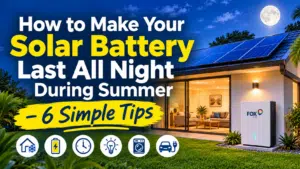
Is your home solar battery running out of power overnight? Discover how to make your battery last longer during hot North Queensland summers, even when you’re running air conditioning.
For eight to nine months of the year, many homeowners in Townsville and North Queensland find that their solar batteries comfortably power their homes throughout the night.
In fact, it’s not uncommon for some of our Horan & Bird Solar customers to wake up at 8am with as much as 50% battery capacity remaining, ready for their solar panels to recharge the battery for another day.
But when summer arrives, everything changes!
As temperatures climb across Queensland, air conditioning becomes one of the biggest consumers of electricity in our homes. Running multiple air conditioners overnight can quickly drain even a large home battery.
A few simple changes to how and when you use electricity can make a significant difference.
Quick Answer: How Can I Make My Solar Battery Last Longer Overnight?
The six most effective ways to help your home battery last through the night are:
- Delay using large lounge room air conditioners where practical.
- Set bedroom air conditioners to 23–24°C instead of 19°C.
- Avoid running multiple air conditioners in separate rooms.
- Heat your hot water during daylight hours.
- Run pool pumps when solar generation is available.
- Take advantage of eligible Ergon Energy free electricity periods to recharge your battery.
Let’s look at how each of these changes can help you get more from your solar and battery system.
- Delay Turning On Your Lounge Room Air Conditioner
Your lounge room air conditioner is often one of the biggest electricity consumers in your home, especially when cooling a large open-plan living area.
And during summer, this can have a major impact on how long your home battery lasts.
For example, a large air conditioner can draw down 10% or more of your battery storage capacity every hour.
Of course, actual electricity consumption varies depending on the size of your air conditioner, temperature settings and how hard the system needs to work.
My Personal Battery-Saving Tip
When I arrive home from work, I try to ventilate the house first to release trapped hot air, and get airflow through the home.
I then delay turning on the lounge room air conditioning until around 6pm, when the sun is lower and the house is hopefully starting to cool.
When I do turn it on, I set the temperature to 25–26°C and run the ceiling fans to circulate the cool air.
My personal goal is to go to bed with 70–80% battery capacity remaining.
This gives us plenty of stored energy to run our bedroom air conditioners throughout the night.
- Set Your Bedroom Air Conditioner to 24°C Instead of 19°C
One of the easiest ways to reduce overnight battery consumption is to increase your air conditioning temperature setting.
Many people set their bedroom air conditioners to 19°C or 20°C, particularly during hot North Queensland nights.
However, the lower you set your air conditioner, the harder it generally needs to work to maintain that temperature.
Increasing the temperature setting to 23–24°C can reduce electricity consumption while still keeping your bedroom comfortable.
How Much Electricity Can Your Air Conditioner Use Overnight?
The table below shows how different average air conditioning loads can affect battery consumption over eight hours.
| Average A/C power draw | Energy used over 8 hours |
| 0.5kW | 4kWh |
| 1.0kW | 8kWh |
| 1.5kW | 12kWh |
| 2.0kW | 16kWh |
| 3.0kW | 24kWh |
These are illustrative examples based on average power consumption, not the air conditioner’s rated cooling capacity. Actual usage varies with temperature, humidity, insulation and equipment efficiency.
As you can see, running multiple air conditioners overnight can consume a significant amount of stored electricity.
My Personal Battery-Saving Tip
Try setting your bedroom air conditioners to 24°C and running your fans on high.
The circulating air can help you feel cooler without needing to set your air conditioner to an unnecessarily low temperature.
And remember, every kilowatt-hour you save overnight is another kilowatt-hour remaining in your battery the next morning.
- Reduce the Number of Air Conditioners Running at Night
If your family is anything like mine, everyone wants to watch something different on television!
The problem isn’t necessarily the televisions themselves.
It’s having three different rooms cooled by three separate air conditioners.
Running multiple air conditioners at the same time can quickly drain your home battery.
My Personal Battery-Saving Tip
Where possible, get the family together in the lounge room to watch television rather than cooling multiple rooms.
Running one air conditioner instead of three can substantially reduce household electricity consumption, depending on the size and efficiency of each unit.
Sounds easy, doesn’t it?
Convincing the family might be the harder part!
- Run Your Electric Hot Water System During the Day
Your electric hot water system can be one of the largest electricity consumers in your household.
If your hot water system is heating water overnight, it could be using valuable energy stored in your home battery.
One of the simplest ways to improve solar battery performance is to schedule your hot water system to operate during daylight hours with a timer when your solar panels are generating electricity.
My Personal Battery-Saving Tip
Have your hot water system on a Timer so it only operates during the day.
This can reduce overnight electricity consumption and help preserve your battery for essential household loads.
- Schedule Your Swimming Pool Pump to Run During Solar Hours
If you own a swimming pool in North Queensland, your pool pump could be consuming more electricity than you realise.
Depending on the pump’s size and operating speed, several hours of filtration can use a significant amount of energy.
Running your pool pump overnight means that electricity may be coming directly from your battery rather than your solar panels.
My Personal Battery-Saving Tip
Where practical, schedule your pool pump to operate during daylight hours when your solar system is producing electricity.
This allows you to use more of your solar generation directly while preserving battery storage for overnight use.
You can also investigate running your pool pump during Ergon’s eligible free electricity period between 11am and 2pm.
I set my pool pump to run from 9am to 3pm each day.
- Use Ergon’s Three Hours of Free Electricity to Charge Your Battery
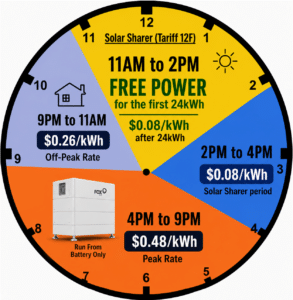
The tariff offers three hours of free electricity between 11am and 2pm each day.
For compatible solar battery systems, it is possible to configure your battery to charge from the electricity grid during this period.
This is particularly useful during extended cloudy or rainy weather when your solar panels aren’t generating enough electricity to fully recharge your battery.
Need help setting up your solar battery app?
Contact the Horan & Bird Solar team. We can help you review your battery settings and determine whether scheduled charging is suitable for your system.
Final Thoughts: Make Your Solar Battery Work Smarter This Summer
At Horan & Bird Solar, we’ve been helping North Queensland households with solar energy for many years, and one thing we’ve learned is that how you use your electricity can be just as important as how much battery storage you have installed.
You don’t always need a bigger battery to get through the night.
Sometimes, a few simple adjustments to your air conditioning, hot water, pool pump and battery charging schedule can make a significant difference.
My goal is to head to bed with around 70–80% battery capacity remaining, giving our household enough stored electricity to comfortably get through the night.
Every home is different, but with the right settings and a few smarter energy habits, you can get much more out of your solar battery this summer.
Need Help Optimising Your Solar Battery?
Horan & Bird Solar team can help you understand how to get the most out of your solar and battery investment.
We can assist with battery charging schedules, energy usage reviews and advice on making your stored electricity last longer.
Contact Horan & Bird Solar and let our team help you get more from your home battery this summer.

Founder of Horan & Bird. Director of Master Electricians Australia and Board Member of Solar Accreditation Australia. John has played a key entrepreneurial role in the transformation of the Energy Landscape in Queensland.